


Description
Related products

THONET
Cantilever Chair S 533 - Mies van der Rohe - 1927
Timeless elegance with the comfort of an armchair: the cantilever chair S 533
1.750,00 €

THONET
Cantilever Chair S 533 L - Mies van der Rohe - 1927
Timeless elegance with the comfort of an armchair: the cantilever chair S 533 L
1.950,00 €

THONET
Cantilever Chair S 533 LF - Mies van der Rohe - 1927
Timeless elegance with the comfort of an armchair: the cantilever chair S 533 LF
2.490,00 €

THONET
Cantilever Chair S 533 N - Mies van der Rohe - 1927
Timeless elegance with the comfort of an armchair: the cantilever chair S 533 N
1.195,00 €

THONET
Cantilever Chair S 533 NF - Mies van der Rohe - 1927
Timeless elegance with the comfort of an armchair: the cantilever chair S 533 NF
1.495,00 €

Christopher Farr
Anni Albers Bauhaus Rug
Based on a textile design by Anni Albers from the 1920s, the English manufacturer Christopher Farr Editions has created this motif as a tepee in two sizes.
From 800,00 €

Designercarpets Drechsle
Bauhaus Rug No. 1 Gertrud Arndt
The colourful composition of the Bauhaus Carpet No. 1 by Gertrud Arndt is a design from 1924.
2.500,00 €

Tecnolumen
Wilhelm Wagenfeld table lamp WG 25 GL
The Bauhaus Table Lamp embodies the essential idea that form follows function, as espoused by the influential Bauhaus school.
630,00 €

Klein & More
Nesting Table Josef Albers
The Nesting Tables powerfully combine clear geometric shapes with colours from Josef Albers' painterly oeuvre.
2.190,00 €

The Bauhaus in 100 Objects
To mark the 100th anniversary of the founding of the Bauhaus, minimum presents in this book 100 legendary style icons and furniture classics.
24,90 €

Taschen Publisher
Mies van der Rohe
This book presents over 20 of Mies van der Rohe's projects from the period between 1906 and 1967 and highlights his groundbreaking ideas and influence in Ame...
15,00 €

Hirmer Publisher
Barcelona Pavillon / Haus Tugendhat
Jewels of architecture: The masterpieces of Mies van der Rohe in brilliant photos.
35,00 €

Bauhaus Movement
Less is more
This was the motto of Ludwig Mies van der Rohe, an advocate of minimalism in architecture.
From 125,00 €

Bauhaus Movement
Less is more
This was the motto of Ludwig Mies van der Rohe, an advocate of minimalism in architecture.
From 125,00 €
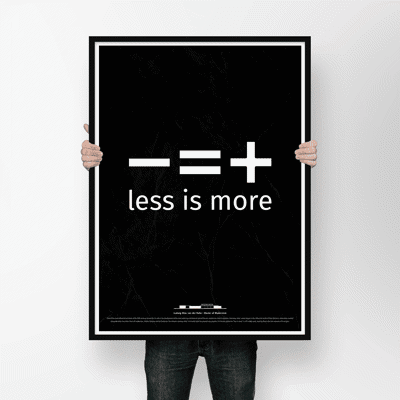
Bauhaus Movement
less is more
This was the motto of Ludwig Mies van der Rohe, a proponent of minimalism in architecture.
From 125,00 €

Bauhaus Movement
Less is more
This was the motto of Ludwig Mies van der Rohe, an advocate of minimalism in architecture. What is less complicated is often better understood and appreciate...
39,00 €

Bauhaus Movement
Mies Barcelona Pavilion
Mies van der Rohe's Barcelona Pavilion is something of an modernist icon in the architecture world. Originally designed for the 1929 World Fair in Barcelona...
39,00 €